
You stand in the grocery aisle holding a carton of berries, mentally calculating whether the total will trigger a text from your partner before you reach your car. At home, you hand over the paper receipt and wait for approval.
Money arguments happen in every household, yet routine budgeting never requires fear, secrecy, or permission to buy basic food. When one partner turns shared finances into a surveillance system, love quickly shifts into quiet captivity.
Learning the signs of financial abuse helps you spot manipulation early, protect your credit, and reclaim real choices. Below, you will find six unmistakable red flags along with clear scripts and concrete legal tools.
Why Financial Control Often Hides in Plain Sight
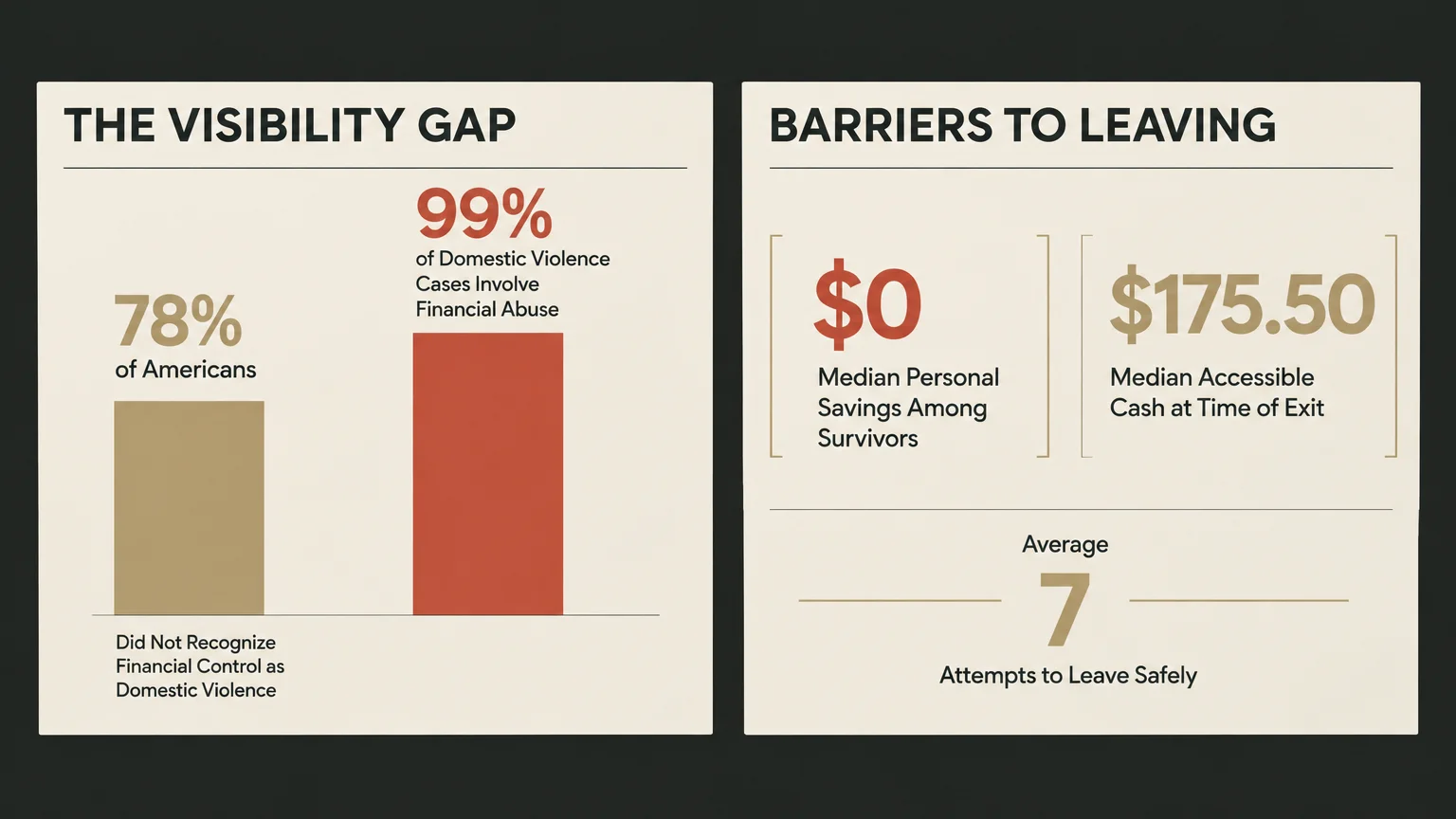
Most people picture domestic harm as bruises or shouting, so subtle economic restrictions rarely raise immediate alarms. According to a 2014 study cited by the National Network to End Domestic Violence, 78% of Americans did not recognize financial abuse as domestic violence.
Yet money sits at the center of nearly every abusive dynamic, both behind closed doors and across shared apps. Research cited by NNEDV from a 2011 Center for Financial Security study shows financial abuse occurs in 99% of domestic violence cases.
NNEDV defines financial abuse as behavior that tries to control how you acquire, use, or maintain economic resources. That control threatens your self-sufficiency and leaves you unable to meet basic needs without another person signing off.
In healthy relationships, couples negotiate spending differently because people carry distinct money histories into partnership. An economic abuse relationship differs because one person demands unilateral power while keeping the other person dependent, confused, or afraid.
The financial toll builds rapidly until leaving feels mathematically impossible. FreeFrom’s August 2022 report, cited by The Allstate Foundation through 2026, found that 92.3% of surveyed survivors experienced economic abuse.
Those same survivors reported a median of $0 in personal savings and just $175.50 in cash they could access without partner interference. Their overall financial well-being sat in the bottom 10th percentile of U.S. adults.
When your accessible cash barely covers a tank of gas and a motel room, walking away requires immense logistical planning. Speaking at the September 2026 Forbes Power Women’s Summit, Allstate Foundation VP Kate Nack noted it often takes seven attempts for a survivor to leave.
This pattern cuts across borders and affects millions of households worldwide. Data from the CDC’s 2023/2024 National Intimate Partner and Sexual Violence Survey show 5.2% of U.S. women—6.7 million people—experienced partner violence or stalking in the prior year alone.
International data reveal similar pressures on women and men living with controlling partners.
Survey findings cited by UK charity Surviving Economic Abuse show 1 in 6 women experienced economic abuse in the prior year, while Respect Victoria reports 16.3% of women and 7.8% of men in Australia have faced financial abuse.
Recognizing a controlling partner around money does not require waiting for an empty bank account. When you understand how these tactics operate day to day, you can trust your discomfort and verify what is actually happening.
6 Red Flags That Your Partner Is Using Money to Control You
Control rarely arrives on a first date with a loud announcement; instead, it creeps in disguised as helpfulness, efficiency, or romance. Watch closely for these six behaviors in both face-to-face conversations and digital accounts.
1. Micromanaging Every Dollar and Auditing Receipts
A partner who offers to manage the household spreadsheet might seem generous during a busy season of life. Red flags appear when that oversight turns into daily interrogation over groceries, tampons, co-pays, or transit fare.
Both NNEDV and the National Domestic Violence Hotline warn against restrictive allowances that fail to cover basic needs like food or medicine. Demanding itemized receipts and counting your remaining change turns routine errands into compliance checks.
Digital banking makes this surveillance effortless from miles away. Your partner might enable instant push alerts on your debit card, comb through your Venmo history, or text demanding to know why you stopped for coffee.
Healthy budgeting tracks shared goals together; coercive micromanagement tracks you. If buying a winter coat or filling a prescription sparks a two-hour lecture, the issue is control rather than thrift.
2. Locking You Out of Accounts and Financial Decisions
Secrecy works alongside surveillance when a controlling partner hoards visibility over household money. They may refuse to add your name to the lease, deny you a debit card, or remove you from joint accounts after an argument.
According to guidance from the U.S. Department of Defense and Military OneSource, hiding household assets, income, or bank statements is a classic tactic of economic control. You have no idea how much money comes in, where it goes, or whether rent was actually paid.
Sometimes this exclusion wears a reassuring smile. A partner might say you are bad at math or tell you not to worry your head over investments, taxes, or mortgage paperwork.
Technology reinforces these walls when one person holds every login, email verification code, and password manager key. If you cannot view your household balance independently in thirty seconds, your financial safety rests entirely on someone else’s mood.
3. Sabotaging Your Job, Schooling, or Career Growth
Financial independence threatens a controller’s leverage, so your paycheck or degree often becomes their primary target. They might forbid you from applying for jobs, mock your career ambitions, or refuse to watch the children on exam mornings.
Sabotage also strikes right before a shift or important client call. A partner may hide your car keys, start a screaming match at midnight before an interview, or show up uninvited at your workplace to embarrass you.
Constant digital harassment creates the same damage for remote workers. Calling twenty times during a Zoom presentation or threatening a crisis until you log off puts your livelihood directly at risk.
Forcing you to work unpaid in a family business also counts as employment sabotage. The Allstate Foundation reports that domestic violence causes 8 million paid workdays lost each year in the United States—equal to 32,000 full-time jobs vanishing annually.
NNEDV’s fact sheet further notes that 50% of survivors lost or left their jobs after experiencing sexual assault. When a partner undermines your income, they ensure you cannot afford an exit.
4. Forcing Debt in Your Name or Tanking Your Credit
Coerced debt happens when a partner uses manipulation, forgery, or threats to saddle you with loans and unpaid bills. They might open credit cards in your name, force you to sign fraudulent tax returns, or max out joint lines of credit.
Even if you earn your own income, sabotaged credit traps you when you try to rent an apartment or finance a reliable car. Refusing to pay utility bills listed solely under your name achieves the same damaging result.
The Consumer Financial Protection Bureau reported in December 2024 that nearly three-quarters of domestic violence survivors stay longer in abusive relationships partly because of coerced debt. Those balances act like invisible handcuffs long after a breakup.
That same CFPB analysis found that women of color carry nearly double the average coerced debt burden. When survivors are able to strip coerced debt from their credit reports, one-third see their scores jump by 20 points or more.
Watch for mail that disappears, unfamiliar collections calls, or sudden pressure to co-sign a loan you barely understand. Consent under fear or confusion is never true financial consent.
5. Weaponizing Shared Digital Bills and Tech Access
Modern relationships run on shared phone plans, smart home hubs, streaming profiles, and cloud storage. A controlling partner can flip a single administrative toggle to isolate you within minutes.
When you share a wireless plan under your partner’s name, they can view who you call and text, suspend your data during a fight, or track your physical location through family-sharing tools.
Threatening to cancel your phone service cuts off your lifeline to friends, employers, and crisis advocates.
Some controllers use smart thermostats, ring cameras, or shared Wi-Fi routers as punishment for crossing a boundary. Locking you out of home internet sabotages remote work, online classes, and telehealth therapy appointments all at once.
If your partner refuses to let you put your own phone number in your own name, pause and ask why. Convenience never requires total digital dependency.
6. Treating Generosity as a Debt You Always Owe
Early in dating, financial control frequently looks like dazzling generosity. Someone insists on paying every restaurant check, showers you with surprise trips, or urges you to quit a stressful job while they cover rent.
Over time, every gift quietly converts into leverage. Whenever you express disagreement, need space, or plan a night out with friends, they recite the exact dollar amount they have spent on you.
Unpaid domestic labor, caregiving, and emotional support suddenly count for zero in their mental ledger. You are made to feel indebted for existing in a home you actively maintain.
This dynamic also spills into chosen family and close friendships when a wealthier partner pays for group dinners only to dictate where everyone sits, eats, or travels. True generosity leaves you freer; manipulative generosity makes you feel smaller.

How Financial Control Looks Across Different Lives and Relationships
Economic abuse does not follow a single script because age, identity, immigration status, and family structure shape every person’s vulnerability. Looking at varied lived realities helps you spot coercion even when your relationship does not look traditional.
Young adults and college students often encounter financial control through digital wallets, campus meal plans, and first off-campus leases. An older or higher-earning partner might pressure a student to drop out and co-sign car loans, leaving them with ruined credit before age twenty-five.
Queer couples and chosen family households frequently share housing, pets, and bills without automatic legal protections like divorce asset division. When a breakup occurs, a controlling ex-partner may empty shared accounts or refuse to transfer utility deposits because no marriage certificate exists.
Women of color and immigrant partners frequently navigate compounded barriers when seeking financial relief. Language isolation, fear of biased policing, and steeper coerced debt burdens make losing access to an individual bank account even riskier.
Disabled partners and full-time family caregivers face uniquely quiet forms of control. A partner or adult family member who acts as a representative payee or caregiver can withhold disability benefits, skip needed assistive supplies, or isolate the person from community support.
Older adults entering late-life dating or living with adult relatives also experience hidden financial coercion. Pressuring an aging partner to sign over property deeds, retirement distributions, or bank passwords steals decades of hard-earned security.
According to NNEDV’s data, women living in poverty experience domestic violence at twice the rate of women above the poverty line. Regardless of your income bracket or household structure, your right to financial autonomy never expires.
Three Communication and Boundary Frameworks to Test the Waters
When you first notice uneven money habits, it helps to tell the difference between fixable clumsiness and entrenched coercion. These three skill frameworks give you grounded ways to speak up while watching carefully how your partner reacts.
1. Communication Boundaries: Asking for Transparency Without Apologizing
In a healthy partnership, money discomfort shrinks when both people put real numbers on the table. Setting a communication boundary means stating clearly what access and information you require without softening your needs into an apology.
You can test transparency calmly during a neutral moment rather than mid-argument. Try saying: “I need full online logins and monthly statements for every account attached to our household, including rent and utilities.”
You can also establish clear boundaries around independent spending money. Try saying: “For our shared budget to feel fair, we each need an equal monthly amount in our own personal accounts with no questions asked.”
Pay close attention to what happens next rather than focusing only on sweet promises. A respectful partner may feel awkward at first, yet they will share passwords and collaborate within a few days; a controlling partner will stall, mock you, or punish you for asking.
2. Conflict Repair: Naming Power Imbalances in Healthy Partnerships
Even loving couples stumble into sharp money fights when bills spike or work slows down. Conflict repair means addressing how a disagreement made you feel unsafe or silenced once voices have cooled.
To repair an uneven dynamic, name the impact of the behavior without attacking your partner’s whole character.
Try saying: “When you raised your voice about the grocery total and asked for the receipt, I felt policed instead of partnered—how can we reset how we talk about food costs?”
If your partner genuinely cares about equality, they will own their reaction and adjust the system together. They might reply: “I panicked about our credit card balance and took it out on you; let us set a shared weekly budget and skip the receipt checks.”
Contrast that repair with DARVO tactics—denying, attacking, and reversing victim and offender. If naming your discomfort triggers stonewalling, threats to cut off funds, or accusations that you are ungrateful, treat that reaction as crucial data.
3. Empathy-Building: Separating Stress From Control
Many adults carry deep scarcity anxiety from growing up in unstable homes or surviving past layoffs. Empathy-building helps you acknowledge a partner’s genuine fear without surrendering your own financial agency to soothe them.
You can validate old money wounds while holding a firm line on shared respect. Try saying: “I know watching your parents struggle made unexpected expenses terrifying for you, and I want us to build an emergency cushion together without tracking every dollar I spend.”
If your partner wants security rather than dominance, empathy opens constructive problem-solving. They might share their anxiety openly and agree to automated transfers into a joint savings account instead of hovering over your bank notifications.
Never confuse chronic coercion with temporary stress. Empathy belongs only in spaces where your safety, voice, and bank access remain fully intact.

Safety, Consent, and Legal Protections When You Need an Exit
Boundaries work only when both people honor consent, emotional labor, and mutual dignity. If testing these conversations escalates anger, threats, or tighter monitoring, stop negotiating with your partner and shift quietly toward personal safety.
You do not owe endless emotional labor to prove that your basic financial rights matter. Pausing shared commitments or planning a discreet exit is a healthy boundary, not a relationship failure.
Because coerced debt and shared digital accounts often keep survivors stuck, U.S. laws and consumer tools offer concrete ways to untangle your life. Start building quiet leverage using steps your partner cannot easily block.
First, check whether your cell phone sits on a shared plan controlled by your partner.
Under the Safe Connections Act of 2022 and rules enforced by the Federal Communications Commission since July 2024, wireless carriers must separate your line—and your dependents’ lines—within two business days of a valid request.
You have the legal right to request that phone line separation even if your partner is the primary account holder. Carriers must also scrub calls and texts made to listed domestic violence hotlines from consumer-facing call logs.
If money is tight during that transition, ask about the federal Lifeline emergency benefit effective since September 2024. Qualifying survivors facing financial hardship can receive up to six months of support—providing up to $9.25 monthly, or $34.25 monthly on qualifying Tribal lands—toward phone or internet service.
Second, quietly inspect your credit history from a safe device, such as a work computer or public library terminal.
Under federal law and bureau policies highlighted by the Federal Trade Commission, you can pull free weekly credit reports from Equifax, Experian, and TransUnion at AnnualCreditReport.com.
You can also call 1-877-322-8228 for annual reports, and Equifax provides six additional free reports per year through 2026.
If you spot accounts you never consented to open, place a free credit freeze at all three bureaus immediately so no new debt can be opened.
Report fraudulent or coerced accounts through IdentityTheft.gov so you have an official federal record while planning next steps. Remember that free credit freezes never hurt your credit score and can be lifted temporarily whenever you legitimately apply for housing.
Third, check whether your state offers dedicated coerced debt relief. According to the National Consumer Law Center, nine U.S. states had enacted coerced debt laws as of May 2026: California, Connecticut, Illinois, Maine, Minnesota, Nevada, New York, Texas, and Vermont.
New York’s statute took effect in February 2026, and Vermont enacted Act 106 in May 2026. Across these states, laws generally require creditors and collectors to pause collection once you submit required documentation and seek removal of confirmed coerced debt from credit reports.
Crucially, many of these state laws accept a signed statement from a victim advocate, social worker, medical provider, mental health clinician, or attorney instead of demanding a police report.
At the federal level, the CFPB issued an advance rulemaking notice in December 2024 to consider classifying coerced debt as identity theft under Regulation V, though the proposal remained in the prerule stage into 2026.
When you are ready to rebuild credit after leaving, explore NNEDV’s Independence Program, which offers credit-building microloans tailored specifically for survivors of financial abuse. If you need confidential, judgment-free planning tonight, domestic abuse help is available around the clock.
In the United States, call the National Domestic Violence Hotline at 1-800-799-SAFE (7233), reach TTY at 1-800-787-3224, chat online at TheHotline.org, or text START to 88788.
Specialized lines listed by The Hotline include the StrongHearts Native Helpline at 844-762-8483, the National Teen Dating Abuse Helpline at 866-331-9474, and the Deaf Hotline videophone at 855-812-1001.
If you live in France, 3919 provides national helpline guidance for women experiencing violence. Always clear your browser history or use a trusted friend’s phone if your partner monitors your digital activity.
Frequently Asked Questions About Money, Dating, and Relationships
How do I maintain friendships when my partner controls our social budget?
Isolation thrives when a partner prices you out of coffee dates, birthday dinners, or quick weekend rides with friends. Start by suggesting free, low-friction ways to stay connected, like neighborhood walks, library study sessions, or phone calls during your commute.
Also keep at least one trusted friend looped into what is happening so shame does not silence you. True friends rarely care whether you split an appetizer; they care that you are safe and reachable.
What is healthy online dating etiquette around money and payment apps?
Early dating should never require sharing bank passwords, splitting high-ticket subscriptions, or answering rapid-fire Venmo requests. Keep first meetings low-cost and independent, pay for your own transit home, and decline any request to receive or forward money on someone else’s behalf.
Watch how a match handles splitting a modest check or honoring your budget limit before moving offline. Someone who mocks your boundaries over a $15 lunch or pushes hurried financial entanglement is showing you their playbook early.
How do I tell cultural financial norms apart from economic abuse in a cross-cultural relationship?
Many cultures view money communally, whether through supporting aging parents, pooling household earnings, or valuing traditional provider roles. Those norms remain healthy only when both partners willingly consent, understand where money flows, and keep genuine input over household choices.
Cross-cultural expectations turn into economic abuse when tradition becomes a shield to silence your questions, strip your legal rights, or trap you without personal money. Culture shapes how couples organize care; it never justifies stripping an adult of autonomy.
How can we set clear financial expectations early in dating or chosen family living?
Before moving in together or splitting shared expenses with romantic partners or chosen family, hold an explicit money conversation. Map out what stays separate, what goes into a shared household pool, and how each person handles existing debt or credit obligations.
Put lease terms, utility responsibilities, and exit agreements in writing while everyone still feels calm and collaborative. Clear written expectations protect friendships and romances alike if incomes shift or living arrangements end.
Your Next Small Step Toward Financial Breathing Room
You do not have to untangle years of shared accounts, coerced bills, or quiet fear before dinner tonight. Big changes start with one small, reversible action that reminds you your future still belongs to you.
This week, pull one free credit report from a safe device, store photos of your ID and lease in a private cloud folder, or text a confidential advocate just to ask questions. Financial clarity is not selfish—it is the foundation every honest relationship deserves.