No alarm wakes you on that first Monday without work, yet an unfamiliar tension settles between your morning coffee mugs. For decades, busy career schedules masked small disconnects that suddenly surface once daily work disappears.
Couples in retirement do not simply inherit extra leisure; they must renegotiate identity, shared money, household chores, and personal space at once. Many partners wish they had talked through those invisible shifts long before the farewell party.
Research reveals why marriage after retirement strains even devoted partners—and practical, therapist-backed habits can help you rebuild closeness with intention.
Why Retirement Catches Long-Term Marriages Off Guard
Leaving the workforce alters far more than your monthly paycheck. In couples therapy, partners often arrive stunned that a season they spent years anticipating feels lonelier than their busiest parenting decades.
When paid work ends, the invisible scaffolding around your week vanishes overnight. Suddenly, unspoken expectations about togetherness, daily purpose, and autonomy collide inside the same kitchen every afternoon.
Demographic data shows how vulnerable long-term partnerships become during this transition. In 2024, the National Center for Family & Marriage Research (NCFMR) at Bowling Green State University noted that nearly 40% of divorcing U.S. adults are 50 or older.
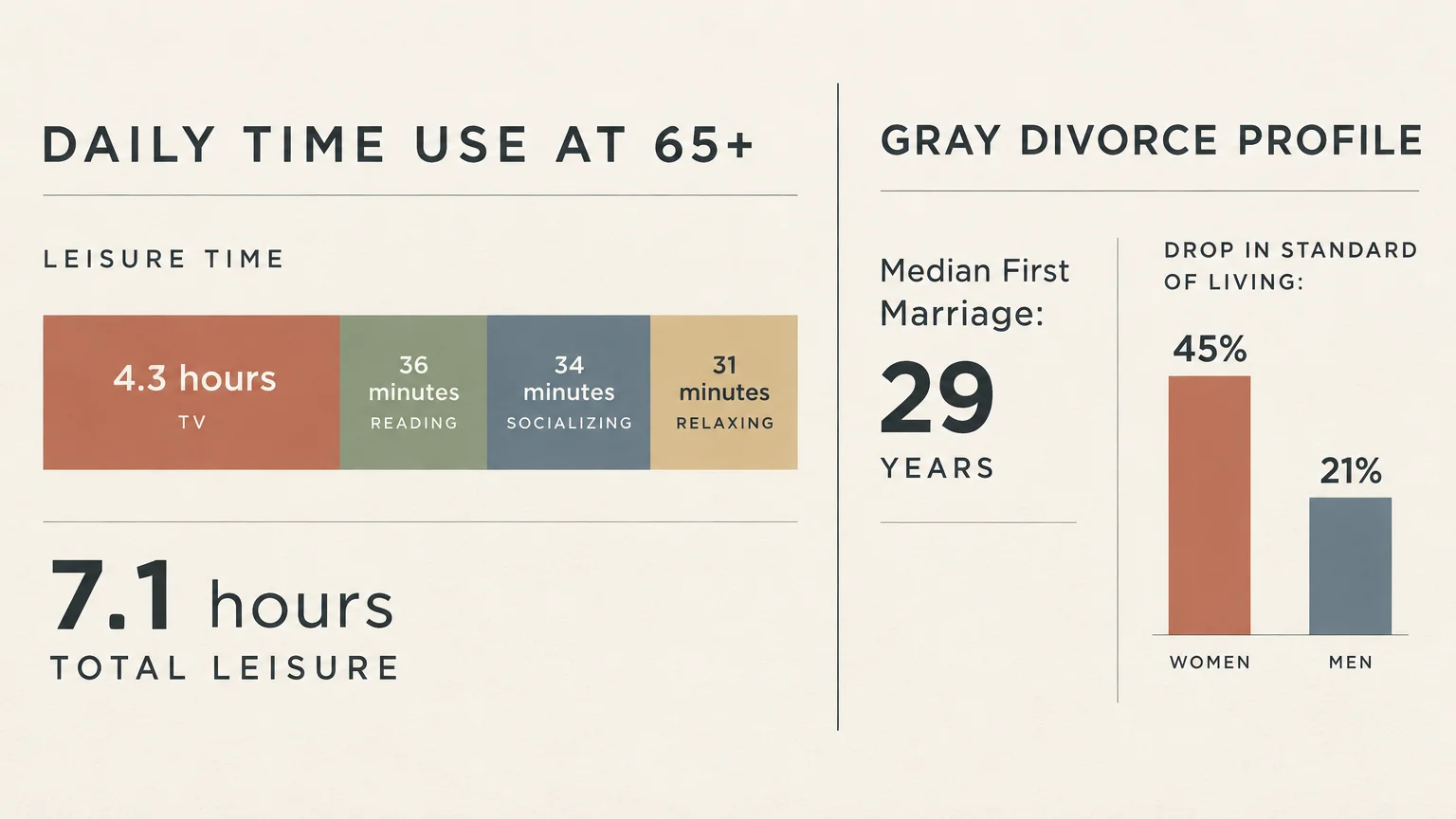
That share has climbed sharply from roughly 8% to 8.7% in 1990. Based on 2022 NCFMR figures, the median length of a first marriage ending in gray divorce is 29 years.
Findings from the Pew Research Center in 2025 sharpen that picture further. In 2023, the divorce rate stood at 10.3 per 1,000 married women age 50 and older, up from 3.9 in 1990.
Across the United States, 22% of divorces ended marriages lasting 25 years or longer. While 50-plus rates plateaued around 2008, Brown and Lin (2022) and Pew Research Center (2025) note that divorce keeps rising among adults 65 and older.
Splitting a shared life later in adulthood brings steep economic fallout alongside emotional grief. Lin and Brown (2021) found that after gray divorce, women experience a 45% drop in standard of living on average, compared with 21% for men.
Wealth also drops by roughly 50% for both partners. Investing in your retirement marriage early protects your emotional well-being and your financial stability alike.
Longer lifespans raise the stakes even higher. Based on 2024 U.S. mortality data from the CDC National Center for Health Statistics released in January 2026, life expectancy at age 65 averages 19.7 additional years.
Men average 18.4 additional years while women average 20.8 years, creating a 2.4-year gap. You are not planning an extended holiday; you are building an entire second act together.
Without fresh structure, retired couples frequently slide into parallel routines. The U.S. Bureau of Labor Statistics (BLS) American Time Use Survey from May 2025 showed adults 65 and older averaged 7.1 hours daily on leisure and sports in 2023.
More than half of that leisure—4.3 hours per day—went to watching television. By contrast, older adults averaged just 36 minutes reading, 34 minutes socializing and communicating, and 31 minutes relaxing and thinking.
Sitting beside each other in front of a screen creates proximity without intimacy. Guidance from the American Psychological Association stresses that major transitions like retirement disrupt established social networks and shared identities.
Both the American Psychological Association and the National Institute on Aging recommend maintaining diverse social support and meaningful outside activities. Your marriage stays warmer when neither partner serves as the other’s sole source of daily stimulation.
The Staggered Timeline Trap and Shifting Household Roles
When One Partner Leaves Work First
Many couples imagine leaving their careers on the same Friday afternoon and launching into travel together. Real retirement timelines rarely align so neatly.
In the 2024 Ameriprise Financial study cited by AARP in April 2025, nearly two-thirds of couples expected to retire within a year of each other. In reality, only 11% left simultaneously, while 62% retired over a year apart.
Even your planned exit date can change without warning. Gallup polling from May 2026 showed non-retired Americans expect to retire at age 66 on average, whereas current retirees actually left at an average age of 61.
Similarly, the Employee Benefit Research Institute (EBRI) 2026 Retirement Confidence Survey found a median retirement age of 62. EBRI and AARP note that 46% of retirees left work earlier than planned—three years sooner on average—due to health, disability, or job changes.
Part-time work blurs the boundary even further. Gallup reported in May 2026 that 58% of employed Americans plan to work part-time in retirement, with 36% wanting to and 21% saying they must.
BLS data from May 2025 confirms that 38.3% of employed Americans age 65 and older worked part-time in 2024. When one partner still commutes while the other enjoys wide-open mornings, unspoken friction easily takes root.
Longitudinal research by Lee and Shehan (1989) and reviews of Cooley and Adorno (2016) show wives often report higher strain when husbands retire while they stay employed. Watching your partner relax while you still juggle deadlines breeds quiet frustration.
Staggered exits affect LGBTQ+ couples, dual-career partners, and culturally diverse households just as deeply. Whenever one partner’s calendar stays rigid and the other’s opens wide, clear communication prevents silent resentment.
Renegotiating Chores Without Quiet Resentment
For decades, you likely split groceries, laundry, repairs, and caregiving around whoever had the lighter schedule. Once careers wind down, those old assumptions collapse.
If the retired spouse treats weekdays like endless weekends while the working spouse keeps carrying half the chores, tension spikes fast. Even when both partners retire, hovering over everyday kitchen routines can feel suffocating.
Research confirms how strongly domestic fairness shapes happiness after work ends. In an AARP national survey of adults ages 55 to 75, retirees whose spouse increased their share of housework reported higher personal satisfaction with retirement.
Stepping into shared chores signals active respect and partnership. Sit down with a blank page and consciously reassign cooking, cleaning, bills, and appointments before unspoken scorekeeping sets in.
Four Research-Backed Repair Strategies for Retired Couples
1. Replace Screen Drift With Daily Rituals of Connection
Lasting intimacy grows from small moments of turning toward each other rather than rare grand gestures. When retired couples skip intentional connection rituals, those 4.3 daily hours of television quietly crowd out real dialogue.
Begin by separating unstructured solo time from protected couple time. When each partner claims dedicated space for reading, hobbies, fitness, or volunteering, afternoon togetherness feels chosen rather than claustrophobic.
Establish one brief morning touchpoint and one evening decompression ritual free from phones or news alerts. Even short, focused check-ins keep you anchored in each other’s inner world.
Sample script for balancing space and closeness: I love having slower mornings together now, and I recharge best with solo time before lunch—could we share coffee first, take independent mornings, and walk together before dinner?
Notice how this framing leads with warmth before requesting independence. Your partner hears affection alongside a clear schedule rather than personal rejection.
2. Use a Soft-Landing Script for Proximity Friction
Sharing a hallway, thermostat, and kitchen counter all day magnifies tiny daily habits. A loud phone call, unwashed mugs, or unsolicited advice about loading groceries can ignite disproportionate irritation.
Underneath surface annoyance usually sits a basic emotional wish: wanting to feel respected, capable, and uncrowded at home. Naming that softer need early interrupts defensiveness before an argument escalates.
Skip sweeping accusations and describe one specific moment followed by a clear request for next time. Keep your voice steady and check that both of you have bandwidth to talk.
Sample script for territorial tension: When you rearrange my prep tools while I am cooking, I feel hovered over—could we split dinner prep tonight so I handle the stove and you handle the table?
If emotions still run hot, ask for a brief pause and state exactly when you will return to finish the conversation. Taking intentional space protects mutual respect far better than snapping in the moment.
3. Practice Radical Financial Transparency Before Crisis Hits
Money anxiety often fuels sharp retirement arguments once regular paychecks stop arriving. Still, many partners avoid honest financial talks until sudden expenses force a crisis.
The Fidelity Investments 2026 Couples & Money Study from May 2026 surveyed 3,193 married and partnered adults and revealed widespread avoidance. Nearly half of couples—49%—skip money talks simply to prevent arguments.
Furthermore, 69% do not regularly discuss long-term finances, and only 31% regularly review day-to-day spending. Nearly one in four partners—24%—admitted hiding a financial secret from their spouse.
Secrecy damages trust far faster than a modest budget ever could. A January 2026 Bankrate survey found 43% of U.S. adults rate financial secrets as bad as physical infidelity.
In that same Bankrate survey, 45% of partnered adults admitted they do not know everything about their spouse’s finances. Hidden accounts or debt leave both partners vulnerable right when income becomes fixed.
At the same time, couples crave stronger financial alignment. Fidelity’s 2026 study showed 53% view aligned money habits as a top relationship driver, and 41% wish they talked long-term finances more often.
Even confident couples uncover sharp blind spots once retirement arrives. In the 2024 Ameriprise Financial study of couples ages 45 to 70 with $100,000 or more in investable assets, 93% shared broad retirement goals.
Yet 25% of those same couples disagreed on how much to spend on travel, hobbies, and experiences. Similarly, Fidelity’s 2024 Couples & Money Study found 53% of non-retired couples disagreed on how much they needed to save.
Replace quiet avoidance with a recurring monthly money conversation led by curiosity rather than blame. Bring coffee, review balances openly, and discuss lifestyle hopes before adjusting budget lines.
Sample script for a blame-free money check-in: I pull back from budget talks when I fear we will clash over travel versus saving—can we review everything openly Sunday afternoon to find a number that feels safe for both of us?
Complete visibility transforms money from a private source of dread into a shared puzzle you solve together. Naming hidden worries early gives both partners room to breathe.
4. Map Healthcare, Benefits, and Caregiving Realities Together
Many couples plan enthusiastically for hobbies and trips while overlooking medical bills, benefits timing, and eldercare realities. Unplanned shocks in these areas strain both your savings and your patience.
According to the Fidelity Investments 2026 Retiree Health Care Cost Estimate from July 2026, a 65-year-old retiring in 2026 needs an average of $185,500 in after-tax healthcare savings. For a couple, that total reaches $371,000—up 7.5% from 2025—and excludes long-term care.
Annual Medicare costs also shape household cash flow. CMS baseline figures for 2026 set the standard Part B monthly premium at $202.90, the Part B deductible at $283, and the Part A inpatient deductible at $1,736.
Income-related IRMAA surcharges begin at $109,000 for individuals or $218,000 for married couples filing jointly. Remember that Medicare eligibility begins at age 65 regardless of when you claim Social Security.
Timing choices with the Social Security Administration directly influence lifelong household security. For anyone born in 1960 or later, Full Retirement Age (FRA) is 67, and claiming worker benefits at 62 permanently cuts monthly payouts by 30%.
A spouse age 62 or older married at least one year—or an eligible ex-spouse—can claim up to 50% of the worker’s FRA benefit once the worker files. Claiming spousal benefits at 62 cuts that share to 32.5% of the FRA amount.
Spousal benefits do not grow if the worker delays past FRA, though survivor benefits do increase. Coordinating these elections together protects whichever partner outlives the other.
Long-term care and family caregiving deserve candid conversation while both partners feel steady. Roughly 70% of retirees will need some long-term care during their lifetime.
Data from the American Association for Long-Term Care Insurance cited by AARP in June 2025 shows timing sharply alters premiums. A $165,000 benefit policy averages $2,080 yearly for a 55-year-old couple versus $3,750 yearly for a 65-year-old couple.
Caring for relatives also affects retirement stability. An October 2026 AARP caregiving study found family caregivers spend $11,508 per year out of pocket on average.
Caregivers who tap retirement savings spend $17,907 annually and devote 49% of household income to care. Talking openly about insurance, care preferences, and family boundaries keeps future emergencies from overwhelming one partner.
Sample script for care and benefits planning: I want us to enjoy these healthy years without guessing about medical bills or caregiving later—let us map out our Medicare bridge, Social Security timing, and care wishes next week.

Why Professional Couples Support Works Better Than Waiting
Many long-married partners hesitate to contact a therapist because they think needing support signals failure. In reality, seeking guidance during a major transition is practical relationship maintenance.
Research published in Family Process in 2022 and cited by AARP in February 2026 highlights how effective counseling can be. The average person completing couples therapy finishes better off than 70% to 80% of people who skip therapy.
A trained clinician helps you spot entrenched patterns—such as one partner pushing harder for conversation while the other shuts down—without blaming either person. Therapy also creates safe ground for grief around aging, changing health, or lost professional identity.
If polite distance or sharp conflict lingers, browse the directory at the American Association for Marriage and Family Therapy to find a licensed specialist. Even brief, focused counseling can reset communication habits for the next two decades.
A Season-Long Roadmap to Rebuild Marriage After Retirement
Phase One: Audit Your Rhythms and Solo Needs
Spend your first month quietly observing how your days unfold without lecturing each other. Notice how much energy goes toward screens, chores, solo interests, and genuine face-to-face connection.
Each partner should then claim dedicated solo commitments outside the house every week. Volunteering, studio classes, fitness groups, faith communities, or part-time consulting preserve individuality and bring fresh stories back to dinner.
Pair that independence with one brief daily check-in focused on feelings rather than logistics. Asking what brought your partner joy or stress today rebuilds emotional attunement quickly.
Phase Two: Align Money, Benefits, and Shared Dreams
During your second month, place every account statement, insurance policy, and benefit estimate onto one shared page. Approach those numbers as allies solving a puzzle rather than judges critiquing past decisions.
Name your distinct comfort zones around travel, home upgrades, hobbies, and charitable giving. Creating a dedicated fun account alongside a protected safety reserve lets cautious and spontaneous partners relax together.
Double-check health coverage gaps if one spouse retires before Medicare begins at age 65. Clear numbers quiet background fear so affection has room to breathe.
Phase Three: Expand Joy, Intimacy, and Community
In your third month, shift deliberate energy toward playfulness, curiosity, and wider friendships. Long-term partnerships stay vibrant when you explore new experiences rather than repeating stale routines.
Pick one shared novelty project each month—a cooking workshop, neighborhood book group, nature club, or day trip somewhere unfamiliar. Invite friends over regularly so your social world widens instead of shrinking around one another.
Hold a relaxed seasonal check-in over breakfast to ask what feels energizing and what feels cramped. Treating retirement as an ongoing experiment keeps small misunderstandings from hardening into distance.

Healthy Safeguards: Boundaries, Sensitive Topics, and Red Flags
Closeness thrives alongside clear personal boundaries. You never have to share every errand, attend every social event as a pair, or force identical sleep and exercise habits.
Expect tender conversations around uneven physical stamina, shifting desire, extended-family financial requests, and cultural expectations around eldercare. Treat differences with curiosity rather than assuming your partner’s limits reflect personal rejection.
Pay close attention to warning signs that your relationship needs professional guidance. Chronic stonewalling, hidden debt, bitter sarcasm, or living emotionally separate lives under one roof rarely heal through silence.
Unilateral choices—such as retiring early without warning, lending major savings to relatives, or planning a move alone—also call for immediate repair. Addressing small fractures promptly protects decades of hard-won trust.
Frequently Asked Questions for Retired Couples
How can we reignite physical and emotional intimacy when routines feel stale?
Lower performance pressure first and restore warm, non-sexual touch throughout ordinary days. Hold hands while walking, linger during hugs, and speak openly about how aging bodies, medications, or energy shifts affect comfort.
Shared novelty outside the house also rekindles curiosity and attraction. When both partners feel emotionally heard during daylight hours, physical closeness follows far more naturally at night.
What if we hold opposite views on spending versus saving in retirement?
Separate the emotional story behind money from the math on your spreadsheet. For many retirees, tight saving represents physical safety, while travel or generosity represents honoring healthy years left.
Test concrete spending scenarios together—or with a fee-only advisor—until both partners feel secure. Agreeing on a firm safety floor calms the cautious spouse while freeing guilt-free room for shared fun.
How do we align on helping adult children or caring for aging relatives?
Set clear household limits before loved ones ask for cash, childcare, or live-in caregiving. Decide privately what time and money you can offer without endangering your own solvency or health.
Cultural traditions and blended-family loyalties often pull partners in opposite directions. Present a unified decision after talking behind closed doors so neither partner becomes the sole target of family frustration.
Can we rebuild trust after hidden debt or a unilateral retirement choice?
Yes, when the partner who broke trust commits to steady, verifiable openness moving forward. Trust returns through reliable actions over months rather than quick pleas to move on.
Share full account access, honor agreed check-ins, and listen to your partner’s hurt without turning defensive. Structured couples counseling helps untangle lingering anger when you feel stuck.
Start Your Next Chapter With One Honest Conversation
Retirement does not break strong marriages; it simply turns a bright light on old habits, money fears, and unspoken hopes. Once you recognize what shifted, you can consciously redesign how you share your days.
Tonight, carve out a few unhurried minutes over tea or an evening stroll to exchange honest reflections. Ask which routine from your working years your partner misses most, and what fresh memory you both want to create this season.
Listen without rushing to fix, thank your partner for speaking openly, and choose one small habit to test tomorrow morning. Your strongest years as retired couples grow from steady, generous conversations—one day at a time.