
You can identify whether your partner displays destructive narcissistic patterns or typical marital stress by examining recurring relational habits. Recognizing these behavioral markers helps you protect your emotional well-being and make informed choices for your marriage.
Living with a self-absorbed partner leaves you feeling emotionally isolated, dismissed, and perpetually off balance. When defensiveness replaces curiosity, ordinary disagreements quickly morph into exhausting power struggles.
Understanding the difference between defensive moments and pervasive character patterns restores your personal clarity. This guide offers clinical insights and actionable frameworks to help you navigate this painful terrain.

The Subtle Shift: From Intimacy to Disconnection
Loneliness inside a marriage feels far heavier than ordinary solitude. You might sit right beside your partner on the sofa while sensing an impassable emotional chasm between you.
Relationship researchers consistently observe that chronic emotional disconnection drives marital dissolution more reliably than overt disagreements. When attunement vanishes, everyday companionship degrades into cold cohabitation.
Every couple experiences selfish moments or defensive squabbles; genuine human intimacy demands room for imperfection. However, persistent toxic relationship signs suggest something deeper than momentary stress or communication fatigue.
Clinical studies highlighted by the American Psychological Association distinguish between fleeting interpersonal defensiveness and deeply entrenched personality structures. Recognizing where your relationship falls on this spectrum provides essential grounding.
10 Signs Your Spouse Exhibits Narcissistic Dynamics
1. Unrelenting Grandiosity and Entitlement
A narcissistic spouse operates under the belief that conventional rules do not apply to them. Whether demanding special treatment in public or expecting unearned deference at home, their entitlement dominates the atmosphere.
Whether you live with a narcissist husband or a narcissist wife, their expectations remain completely one-sided. They expect you to bend your schedule, desires, and personal values to accommodate their supreme convenience.
2. The Profound Empathy Deficit
Empathy requires pausing one’s self-interest to feel someone else’s emotional reality. When you share grief, physical pain, or work exhaustion, a self-absorbed partner responds with apathy or irritation.
They may feign concern when an audience is watching; behind closed doors, however, your tears are treated as personal inconveniences. This pervasive lack of attunement leaves you emotionally starved within your own home.
3. Chronic Blame-Shifting and Weaponized Defensiveness
In healthy relationships, partners can reflect on mistakes and offer sincere apologies. A spouse with rigid narcissistic traits reflexively flips every grievance back onto you.
If you gently bring up an unpaid bill or a forgotten promise, they attack your tone or bring up your past errors. You enter the room seeking resolution and leave apologizing for speaking up.
4. Conversational Hijacking and Competitive Listening
Conversations with a self-absorbed spouse always circle back to their achievements, grievances, or desires. Even your moments of celebration are swiftly reframed around their contributions.
If you describe a grueling workday, they immediately insist their day was significantly more stressful. They listen solely to prepare their rebuttal or redirect the spotlight rather than connecting with you.
5. Systematic Gaslighting and Reality Distortion
Gaslighting erodes your confidence in your own memory, perception, and sanity. Your partner may flatly deny uttering hurtful remarks you heard minutes earlier.
Phrases like “you are imagining things” or “you are far too sensitive” become daily conversational refrains. This manufactured mental fog is one of the clearest signs of narcissism in a domestic relationship.
6. Fragile Ego Masked by Explosive Rage
Beneath outward arrogance lies an exceptionally brittle self-esteem. Any perceived slight, mild critique, or minor boundary triggers disproportionate fury or icy withdrawal.
You find yourself walking on eggshells, constantly monitoring their mood to prevent sudden outbursts. This defensive volatility keeps the entire household in an exhausting state of chronic vigilance.
7. Intermittent Reinforcement and Emotional Breadcrumbing
No toxic relationship starts with constant cruelty; unpredictable cycles of warmth keep you hooked. Your spouse showers you with lavish affection just as you prepare to detach.
Relationship experts identify this intermittent reinforcement as the foundation of traumatic bonding. You endure weeks of cold neglect hoping for that rare jackpot of tenderness from your early dating days.
8. Contempt for Boundaries and Personal Autonomy
Healthy partners celebrate each other’s separate friendships, career passions, and personal space. A narcissistic partner interprets your independent interests as a threat or direct betrayal.
They routinely read your private messages, belittle your chosen mentors, or demand undivided attention during your personal downtime. They view your boundaries as personal insults rather than healthy limits.
9. Transactional Exploitation of Intimacy
In a healthy union, generosity flows from mutual affection and shared joy. For a partner high in narcissistic traits, every favor, gift, and romantic overture carries a hidden price tag.
They keep a meticulous mental tally of everything they have ever provided for you. Later, they leverage these past actions to demand immediate compliance during unrelated disagreements.
10. The Public Persona Versus Private Coldness
To friends, neighbors, and colleagues, your spouse appears exceptionally charismatic, generous, and emotionally insightful. Community members frequently tell you how lucky you are to share a life with them.
Once the front door closes, the charming mask drops, replaced by a brooding, hypercritical stranger. This stark contrast deepens your isolation, making you question whether anyone would ever believe your experience.
Clinical Perspectives on Narcissistic Defensiveness
Decades of observational research by The Gottman Institute show that contempt is the single greatest predictor of divorce. Narcissistic communication relies heavily on eye-rolling, mockery, and perceived moral superiority.
Dr. John Gottman observes that contempt actively degrades both emotional safety and physical immune functioning between partners. When superiority replaces mutual regard, collaborative problem-solving becomes functionally impossible.
Similarly, Emotionally Focused Therapy, developed through the International Centre for Excellence in Emotionally Focused Therapy, highlights attachment security. Healthy marriages thrive when both partners can be emotionally accessible, responsive, and engaged.
Attachment theory reveals that individuals with severe narcissistic adaptations often externalize their anxiety through dominance, blame, and stonewalling. Without mutual humility, partners remain locked in endless cycles of attack and withdrawal.
Licensed marriage therapist Dr. Marcus Vance explains that personality rigidity prevents the safe vulnerability necessary for lasting repair. Sustainable transformation requires your partner to acknowledge their emotional blind spots without shifting blame.
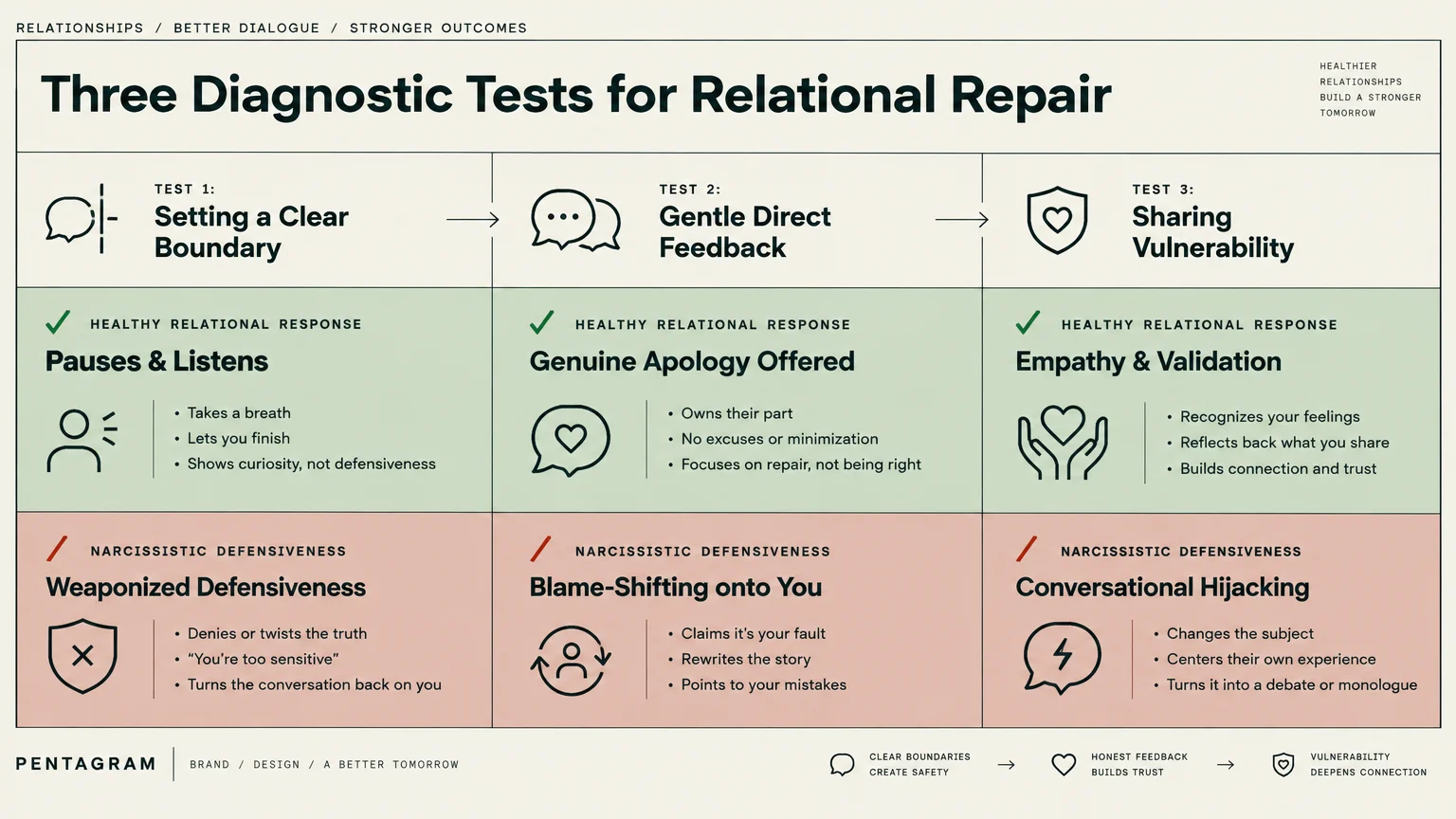
Three Evidence-Based Strategies to Test Relational Repair
1. Structured Rituals of Emotional Reconnection
To rebuild genuine intimacy, you must test whether your partner can engage in structured, distraction-free connection. Establish a non-negotiable ten-minute daily debrief where each person shares without receiving unsolicited advice or judgment.
Initiate this practice with calm directness: “I want to feel closer to you tonight; can we spend ten minutes listening to each other’s day without checking our phones?”
Observe your spouse’s response carefully. If they participate with open curiosity, relational repair is possible; if they mock the exercise or dominate the floor, deeper resistance exists.
2. De-escalation Scripts and Boundary Anchors
High-conflict cycles escalate rapidly when defensiveness takes over. Developing pre-planned verbal boundaries allows you to stay grounded without absorbing unfounded blame.
When your partner launches into a verbal tirade, deploy this clear script: “I want to hear your perspective, but I will not participate in a conversation involving raised voices or insults.”
Follow the script with immediate, consistent physical action: “I am stepping into the garden for fifteen minutes; let us revisit this discussion once we are both calm.”
3. Complete Financial Transparency and Joint Governance
Financial secrecy and control frequently serve as primary levers of domestic coercion. To establish safety, institute a transparent monthly money summit with full visibility into all bank accounts, credit cards, and investments.
Frame the conversation around shared marital stability rather than personal suspicion: “Our family needs absolute financial clarity, so let us review all account balances and upcoming expenditures together every Sunday evening.”
If your spouse responds with evasiveness, anger, or hidden debt, you are encountering coercive control rather than healthy partnership. True marital unity requires equal access to all financial resources and joint decision-making.
A 30-Day Clarity and Action Roadmap
Navigating this marital crossroad requires an intentional, step-by-step roadmap to assess whether your marriage can evolve into a safe union.
During the first ten days, shift your focus entirely toward personal grounding and emotional observation. Document your daily interactions in a secure journal, noting moments of genuine empathy versus patterns of gaslighting or defensive hostility.
From day eleven through day twenty, implement explicit conversational boundaries without offering explanations or apologies. Practice remaining calm during disagreements, using short boundary scripts to decline emotional baiting or projection.
During this middle phase, propose structured couples therapy with a licensed clinician specializing in personality adaptations. Notice whether your partner accepts help humbly or dismisses counseling as an unnecessary insult.
Across the final ten days, evaluate the empirical evidence your partner has demonstrated throughout the month. If your spouse shows genuine self-reflection and respects your boundaries, continue clinical work together with cautious optimism.
Conversely, if their hostility, blame-shifting, and contempt intensified under healthy boundaries, you possess the objective clarity needed to plan your next life chapter.

Essential Safeguards and Healthy Boundaries
Establishing boundaries is not about punishing or controlling your spouse; boundaries simply define what behaviors you will permit around yourself. You cannot force another adult to cultivate empathy or drop their defensiveness.
You can, however, decide how long you will stay in a room where you are degraded or invalidated. Clear limits protect your nervous system from chronic deterioration.
When evaluating professional support, seek credentialed professionals through the American Association for Marriage and Family Therapy. Specialized couples therapists understand how to spot manipulative presentations in the therapy room.
If you experience verbal intimidation, financial isolation, or threats, individual counseling should precede any joint therapy sessions. Couples counseling can inadvertently empower a manipulative spouse if safety has not been firmly established first.
Build an outside support network of trusted friends, family members, or individual support groups. Combating isolation is your greatest safeguard against normalized emotional manipulation.
Frequently Asked Questions
Can a narcissistic spouse rebuild authentic sexual and emotional intimacy?
Authentic intimacy requires mutual vulnerability, which feels profoundly threatening to someone with rigid narcissistic defenses. While behavior can improve through dedicated individual psychotherapy, true emotional depth remains difficult for them to sustain.
If your partner actively engages in long-term therapy and embraces emotional discomfort, modest intimacy can gradually develop. However, you must avoid mistaking performative charm for enduring emotional attunement.
How should you manage shared finances when your spouse hides or controls money?
You must establish immediate legal and digital visibility over all household marital assets. Request comprehensive copies of tax filings, debt disclosures, and account statements without allowing emotional diversion.
If your spouse refuses equal transparency, establish an independent banking account in your name to safeguard essential living funds. Consult a qualified family law attorney or financial advisor to protect your long-term security.
How can you maintain parenting alignment alongside a self-centered co-parent?
Focus on maintaining a calm, emotionally validating environment whenever your children are with you. Children thrive when at least one parent models emotional regulation, honesty, and unconditional affection.
Avoid arguing with your spouse in front of your children; instead, counter subtle manipulation with steady reality testing. Reinforce to your kids that love is unconditional and never earned through performance.
Is complete trust restoration possible after years of manipulation and gaslighting?
Rebuilding trust after pervasive gaslighting requires consistent, verifiable behavior over an extended period. Words, romantic gifts, and promises are entirely meaningless without documented changes in daily conduct.
Your partner must demonstrate full transparency, accept complete accountability for past distortions, and tolerate your skepticism with patient grace. If they demand instant forgiveness, genuine healing has not yet begun.
A Shared Path Forward and Daily Grounding
Your emotional integrity, personal dignity, and psychological sanity are worth defending under all circumstances. Whether your marriage undergoes profound clinical transformation or you eventually choose a separate path, your clarity starts today.
Practice this daily grounding affirmation before entering difficult conversations: “I trust my reality, I honor my emotional needs, and I deserve relationship security.”
True marital connection is built upon mutual reverence, shared tenderness, and unwavering emotional safety. Hold yourself and your partner to that noble standard, and let truth guide your journey forward.